Having skied 56 lift-linked ski areas across 11 countries, we have learned that choosing a European ski resort involves much more than comparing piste kilometres or finding a good hotel. The right choice depends on who is travelling, when they want to go and how much of the mountain they will actually be able to ski.
Here is how we approach the decision, and what we check before recommending a resort.
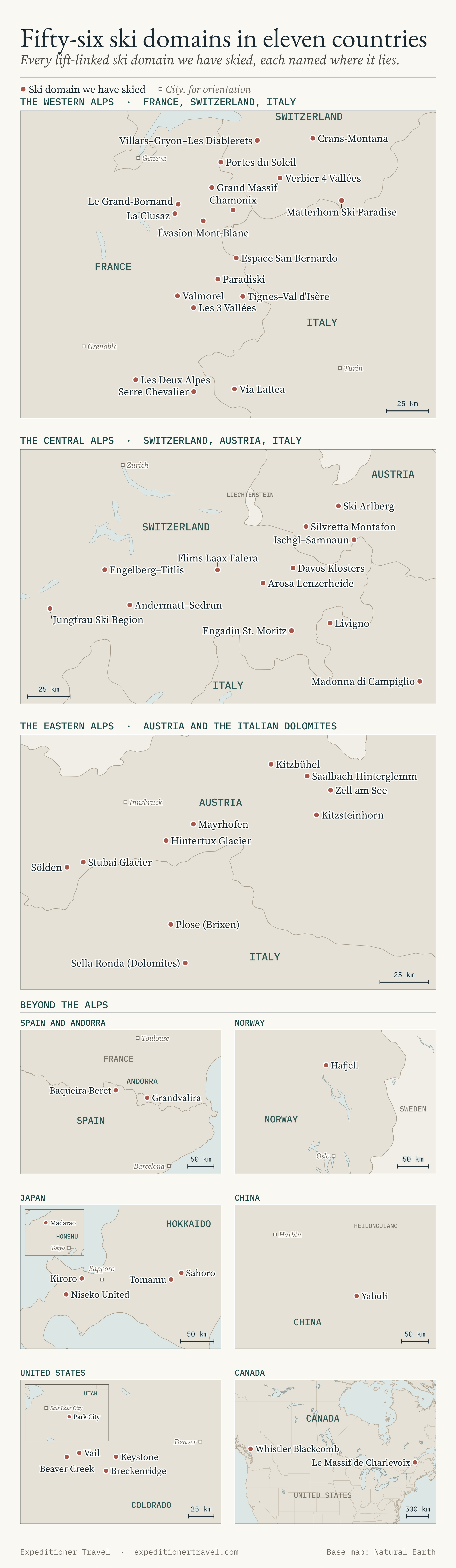
Every lift-linked ski domain we have skied, forty of them in the Alps. The eleven countries: France, Switzerland, Italy, Austria, Spain, Andorra, Norway, Japan, China, the United States and Canada.
1. Start with the people and the dates
Before we suggest a ski area, we establish five things: travel dates, including whether they fall during school holidays; who will ski and who will not; everyone’s skiing ability; the budget per person; and the airports the group will fly from.
These answers narrow the choice considerably. A resort that works well for experienced skiers travelling in February may be entirely unsuitable for a family with beginners travelling in early December.
2. Check snow reliability and how much will be open
The dates determine much more than the price. School holidays generally mean busier slopes, longer lift queues and higher accommodation costs. Early or late in the season, the more important question is whether there will be enough suitable terrain open for your group.
Altitude matters, but so does where you will actually ski. A high summit is of limited use to beginners if the nursery slopes lower down are closed. We therefore look at likely snow conditions and the planned opening dates of the relevant lifts and sectors, rather than relying on the resort’s headline season dates.

Above the clouds at Mayrhofen, Austria
3. Keep the transfer in proportion to the trip
For a week’s skiing, we generally look for an airport transfer of no more than two to three hours. For a fortnight, we are more willing to consider three to four hours if the destination justifies it.
A long transfer takes time out of both the first and last days. On a shorter trip, a resort closer to the airport may offer an equally good holiday with considerably less travelling. Over two weeks, the extra journey can be a more reasonable trade-off.
SkiDomain’s study, Which ski areas have the shortest airport-to-resort transfers?, brings together airport-to-village planning estimates and their sources. Its map also shows the airport used for each ski area.
4. An open resort does not mean an open ski area
Large ski areas often open in stages, with higher sectors opening before the full lift network. Booking during the advertised season therefore does not necessarily mean you will have access to the whole mountain.
For early-season trips, Val Thorens, Zermatt, Hintertux, Saas-Fee and Tignes–Val d’Isère are among the areas we consider first, based on our experience. High-altitude terrain and glacier access can improve the options, but neither guarantees that the runs your group needs will be open. We check the actual operating plans before recommending a booking.

The Plaine Morte Glacier, Crans-Montana, Switzerland
SkiDomain’s study, Skiing at Thanksgiving and Christmas 2026: what is scheduled at 69 ski areas, separates the first lift openings from the main-area season and identifies dates that operators have yet to publish. For a trip in early December or late April, that distinction can make a considerable difference. Planned dates also remain subject to conditions.
5. Choose the village as carefully as the mountain
For a group of keen skiers spending all day on the slopes, the terrain is usually the priority. However, when non-skiers or children in ski school are travelling, the village and the practical arrangements deserve just as much attention.
Restaurants, activities, access to ski school and the distance between the hotel and the lifts all affect how enjoyable the week will be. In these circumstances, a smaller ski area with the right village can be a better choice than a larger one that makes daily life difficult.

Livigno, Italy: the village below the slopes
6. Three ski areas we frequently recommend
Ski Arlberg: One of our preferred choices for strong skiers, with a wide choice of villages offering very different experiences. St. Anton suits those looking for lively après-ski; St. Christoph and Zürs appeal to guests who enjoy traditional, locally run ski hotels; and Lech is a strong choice for high-end luxury.

Zürs am Arlberg, Austria
Verbier 4 Vallées: A strong choice for experienced skiers looking for challenging terrain in Switzerland. Verbier combines a glamorous atmosphere with lively après-ski, while Veysonnaz appeals to families and Nendaz offers a quieter alternative.

An itinerary run in the Verbier sector, Switzerland
Les 3 Vallées: A particularly good option for groups with different skiing abilities, thanks to its extensive terrain and varied choice of villages. The key is choosing a base that suits everyone in the party.
In all three areas, choosing the village is as important as choosing the ski area. This is one of the reasons we built SkiDomain. Its pages on Ski Arlberg, Verbier 4 Vallées and Les 3 Vallées explain the village options, while its matching tool recommends an area and village for your group and explains the choice.
7. Why Europe is often our first choice
In our experience, Europe often offers better value than North America, particularly when lift passes and accommodation are considered together. Good deals can still be found in North America, but they have become harder to find.
That does not make every European resort a bargain. We compare the overall cost and the experience the group will get, rather than assuming that a destination offers good value simply because it is in the Alps.
8. Factor in the pass you already hold
Many clients already have an Epic or Ikon pass. In that case, we start with the European ski areas covered by their pass, then assess which ones suit their abilities, dates and preferred village atmosphere.
A pass helps narrow the choice, but it should not be the only reason to choose a resort. Our guide to the Epic Pass in Europe explains which areas suit different types of skier. We also check the applicable access conditions before confirming the trip.
9. Check the practical details before booking
Before we confirm a trip, we check the hotel’s position in relation to the pistes and lifts; the sectors scheduled to operate during the stay; and whether the transfers work with the arrival and departure flights.
For families, we also check ski-school availability and English-language instruction where needed. For non-skiers, we look at what they can realistically enjoy during the week. These details are easy to overlook when booking from a hotel listing, yet they can determine whether the holiday works for everyone.

Six Senses Crans-Montana, Switzerland, just above the main gondola in Crans: ski-in, ski-out
10. Choose the resort that fits the whole holiday
The best choice is the ski area and village that work for your group on your travel dates. Snow reliability, suitable terrain, manageable transfers and the right base all matter more than the resort’s reputation alone.
To get started, SkiDomain asks the same initial questions we do and recommends a ski area and village in about three minutes. You can then contact us directly from the result to discuss the recommendation and plan the trip.
Not sure which mountain is yours? Here are two useful next steps.
Run SkiDomain Talk to Marc